Here is a scenario many Nigerian business owners know too well.
You put money into Facebook ads. You hire someone to manage your Instagram. You post content for three months. And at the end of it, you cannot point to a single customer that came directly from any of it.
This is not because digital marketing does not work in Nigeria. It works spectacularly well for businesses that approach it with the right strategy. The problem is that most Nigerian businesses jump into tactics before building a strategy. They boost posts without understanding targeting. They create content without knowing who they are creating it for, and run ads without a clear conversion path.
The result is wasted budget, frustration, and the false conclusion that “digital marketing does not work for my kind of business.”
This guide, “Digital Marketing Strategy for Nigerian Businesses in 2026”, exists to change that. We will walk you through the digital marketing strategy that is genuinely moving the needle for Nigerian businesses in 2026, channel by channel, step by step, with specific examples from the Nigerian market.
| WHAT YOU WILL LEARN IN THIS GUIDE |
| ✓ Why most Nigerian businesses waste their digital marketing budget ✓ How to define your target audience with precision (the step most skip) ✓ The most effective digital marketing channels in Nigeria right now ✓ How to run Facebook and Instagram ads that actually convert ✓ Content marketing that builds trust and drives organic growth ✓ Email marketing — still the highest ROI channel available ✓ How to measure what’s working and cut what isn’t ✓ A realistic 90-day digital marketing roadmap for Nigerian businesses |
Why Most Nigerian Businesses Waste Their Digital Marketing Budget
Before we talk about what works, it is worth being direct about what does not, and why.
The single most common digital marketing mistake Nigerian business owners make is starting with tactics instead of strategy. They see a competitor running Instagram ads and immediately want to run Instagram ads. They hear about content marketing and start writing blog posts about topics nobody searches for. They boost posts to a broad audience and wonder why nobody buys.
Digital marketing without strategy is just digital spending. The difference between businesses that get results and businesses that get frustrated comes down to four fundamentals:
1. Clear audience definition.
You cannot market to everyone effectively. The businesses winning online in Nigeria right now know exactly who their ideal customer is; their age, location, income level, specific problem, and what language resonates with them.
2. A defined conversion path.
What happens after someone clicks your ad or reads your post? If the answer is “they come to our website and hopefully contact us,” your conversion rate will be low. Every digital marketing activity needs a clear, deliberate next step.
3. Consistency over bursts.
One month of heavy posting followed by two months of silence does more harm than good. Digital marketing compounds; the results build over time with consistent effort.
4. Measurement and iteration.
If you are not tracking which activities are driving results, you are flying blind. The businesses growing fastest online in Nigeria are the ones that measure everything, cut what does not work, and double down on what does.
The Nigerian Digital Landscape in 2026: What You Need to Know
Before choosing your marketing channels, understand the environment you are operating in. Nigeria’s digital landscape has specific characteristics that should directly influence your strategy.
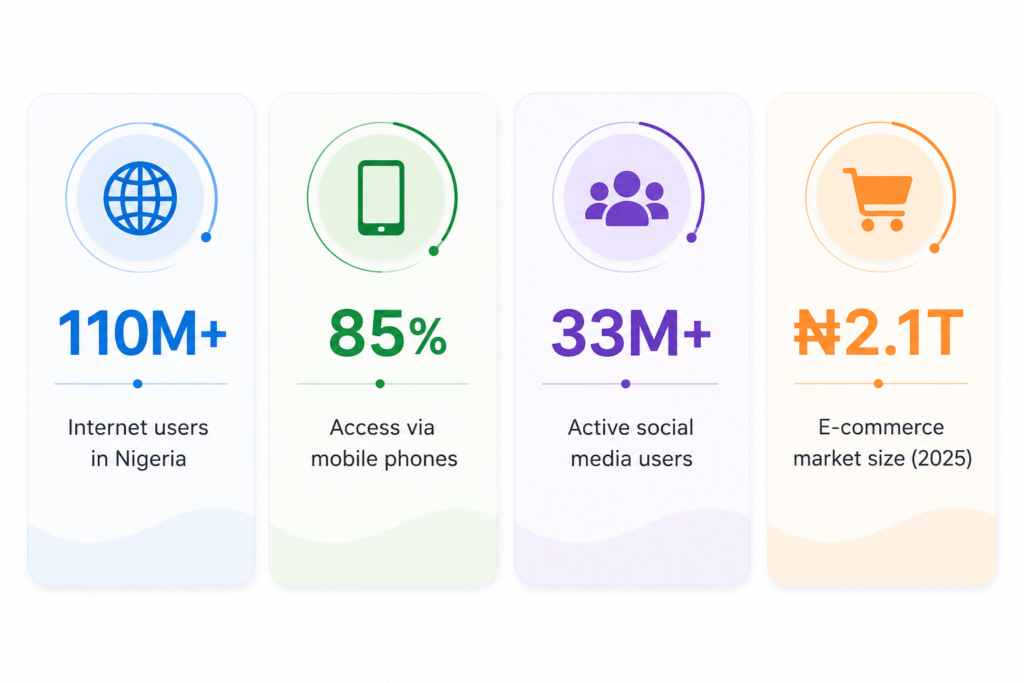
Key implications for your digital marketing strategy:
- Mobile-first is non-negotiable. Your website, ads, emails, and landing pages must work perfectly on a smartphone screen. If your website loads slowly on a mobile data connection, you are losing customers before they ever see your offer.
- WhatsApp is an essential marketing channel, not just a messaging app. With over 50 million active users in Nigeria, WhatsApp is where purchasing decisions are being made, referrals are shared, and customer service is expected to happen.
- Trust signals matter more in Nigeria than in many other markets. Nigerian consumers have been burned by online scams and fake businesses. Social proof — real customer reviews, team photos, video testimonials, verified social media profiles — directly impacts conversion rates.
- Local context drives engagement. Content that speaks directly to the Nigerian experience, referencing local challenges, local success stories, and local pricing in naira — consistently outperforms generic content.
Step 1: Define Your Target Audience With Precision
This is the step most Nigerian businesses either skip entirely or do superficially — and it is the reason most digital marketing fails.
Defining your target audience is not just naming a demographic. It is building a detailed picture of the specific person you are trying to reach. Marketing professionals call this a customer persona or buyer persona.
For a digital marketing or web design agency targeting Nigerian SMEs, a well-defined persona might look like this:
EXAMPLE CUSTOMER PERSONA
Name: Chidinma (fictional composite)
Age: 34 | Location: Lagos (Lekki/Victoria Island area)
Role: Founder of a 3-year-old fashion retail business with 8 staff
Revenue: ₦15M–₦40M annually, growing but not yet at scale
Problem: Getting consistent customer orders online. Currently relies on Instagram DMs and referrals, which are unpredictable.
Goal: A professional website with online ordering and a digital presence that brings in customers without constant manual effort
Where she spends time online: Instagram, LinkedIn, YouTube, WhatsApp
What she distrusts: Generic agencies that don’t understand Nigerian market realities. What would make her hire: A local agency with proven results, transparent pricing in naira, and clear communication
Build two or three personas like this for your business. Every piece of content you create, every ad you run, every email you send should be written for one of these specific people — not for a vague, general audience.
Step 2: Choose the Right Digital Marketing Channels
Not every digital marketing channel will be right for your business. The right channels depend on where your target audience spends time, what your budget allows, and what resources you have to execute consistently.
Here is an honest breakdown of the most effective channels for Nigerian businesses in 2026:
| Social Media Marketing | What it is: Creating and publishing content on platforms like Instagram, Facebook, LinkedIn, and X (Twitter) to build brand awareness, engagement, and community. Best for: Brand building, community engagement, driving traffic, top-of-funnel awareness Nigeria tip: Instagram and Facebook dominate for B2C. LinkedIn is essential for B2B and professional services. TikTok is growing rapidly among the 18–35 demographic. Post in a mix of English and relatable Nigerian expressions for higher engagement. |
| Paid Social Advertising | What it is: Running targeted paid ads on Facebook, Instagram, and LinkedIn to reach specific audiences beyond your existing followers. Best for: Lead generation, product sales, event promotion, driving immediate traffic Nigeria tip: Facebook and Instagram ads offer some of the best cost-per-lead ratios available for Nigerian businesses. ₦50,000–₦150,000/month is a realistic starting budget for a focused campaign. Always target by location (specific states or cities) rather than all of Nigeria to reduce waste. |
| Content Marketing | What it is: Creating valuable, educational, or entertaining content (blog posts, videos, infographics, podcasts) that attracts and nurtures your target audience. Best for: SEO traffic, thought leadership, trust building, long-term lead generation Nigeria tip: Blog content targeting Nigerian search terms drives consistent organic traffic over time. YouTube is the second-largest search engine in the world and is heavily used in Nigeria, video content that solves real Nigerian business problems performs exceptionally well. |
| Email Marketing | What it is: Building a list of prospects and customers and communicating with them directly via email — newsletters, promotional emails, automated sequences. Best for: Nurturing leads, customer retention, promotions, high-ROI direct communication Nigeria tip: Email marketing has the highest ROI of any digital marketing channel globally, typically ₦3,600 return for every ₦100 spent. Yet most Nigerian businesses do not have an email list at all. Start building yours immediately. |
| WhatsApp Marketing | What it is: Using WhatsApp Business and WhatsApp Broadcast lists to communicate with customers, share promotions, and provide customer service. Best for: Customer retention, flash sales, appointment reminders, post-purchase communication Nigeria tip: WhatsApp has a 98% open rate in Nigeria, compared to around 20% for email. For businesses with an existing customer base, a properly managed WhatsApp broadcast list is one of the fastest ways to drive repeat purchases and referrals. |
| Search Engine Marketing | What it is: Running paid ads on Google (Google Ads / Pay-Per-Click) to appear at the top of search results for specific keywords. Best for: Capturing high-intent buyers actively searching for your service or product Nigeria tip: Google Ads can be expensive for competitive keywords in Nigeria, but targeting long-tail, location-specific keywords keeps costs manageable. Best used alongside SEO, ads give immediate visibility while your organic rankings build over time. |
Step 3: Build a Social Media Presence That Converts, Not Just Impresses
Many Nigerian businesses have social media pages that look good but generate no revenue. The problem is almost always the same: they post content designed to impress rather than content designed to convert.
A social media strategy that drives real business results has three layers:
Layer 1 — Content That Attracts
This is educational, entertaining, or relatable content that reaches people who do not yet know your business. On Instagram and Facebook, this means Reels and videos. On LinkedIn, this means insightful posts and articles. On X, this means threads and takes that people share.
For a Nigerian digital marketing or web design agency, attractive content might include:
- “3 reasons your Nigerian business website is losing customers” — a carousel post
- “Before and after: how we redesigned a Lagos brand’s website and tripled their enquiries” — a case study post
- “How much should a website cost in Nigeria? An honest answer” — a video or thread
Layer 2 — Content That Builds Trust
Once someone has seen your content, they need reasons to trust you before they will enquire or buy. This layer includes client testimonials and case studies, team content that shows the real people behind your business, behind-the-scenes content that demonstrates your process and professionalism, and user-generated content from happy clients.
Layer 3 — Content That Converts
This is direct, clear content that asks people to take an action. A limited-time offer. A free consultation. A specific problem you solve with a specific result and a link to book a call. Without this layer, your social media is a branding exercise rather than a business tool.
The ratio that works well for most Nigerian B2B and B2C businesses: 60% attraction content, 30% trust content, 10% direct conversion content.
Step 4: Running Facebook and Instagram Ads That Actually Convert
Facebook and Instagram ads remain the most accessible and cost-effective paid digital marketing channels for Nigerian businesses. But there is a significant gap between ads that drain your budget and ads that generate a consistent flow of qualified leads.
The Four Elements of a Winning Nigerian Facebook Ad
1. The right audience.
Avoid targeting “Nigeria” as a whole unless your product genuinely applies to everyone. Narrow your targeting by city (Lagos, Abuja, Port Harcourt), age range, interests, and where possible, by behaviours like “small business owners” or “online shoppers.” If you have an existing customer list, use it to create a lookalike audience — Facebook will find people similar to your best customers.
2. A scroll-stopping creative.
The first 1–2 seconds of your ad determine whether someone stops scrolling or keeps going. Use real photos and videos over stock imagery — Nigerian audiences have become highly attuned to generic visuals and disengage from them quickly. Show real results, real people, real environments.
3. A clear, specific offer.
“We build websites” is not an offer. “Get a professional business website built in 14 days — starting from ₦150,000” is an offer. Specificity converts. Vagueness does not.
4. A landing page that closes the deal.
Sending ad traffic to your homepage is one of the most common and costly mistakes Nigerian businesses make. Build a dedicated landing page for each campaign, one that matches the ad’s message exactly, removes distractions, and has a single, clear call to action.
Budgeting Realistically
A common question from Nigerian business owners is: how much should I spend on Facebook ads?
The honest answer is that it depends entirely on your cost per lead and what a customer is worth to your business. But as a general starting point:
- ₦30,000–₦80,000 per month is a testing budget, enough to gather data but not enough to scale
- ₦150,000–₦400,000 per month is where most Nigerian businesses start seeing consistent, predictable lead flow
- Scale your budget only after you have found an ad combination that converts profitably at a smaller spend
Step 5: Content Marketing That Builds Authority and Drives Traffic
Content marketing is the discipline of creating valuable content that attracts your target audience, builds your credibility, and ultimately converts readers and viewers into customers.
For Nigerian businesses, the most effective content formats in 2026 are:
i. Long-form blog posts (1,000–2,500 words)
Targeting specific Nigerian search terms. These drive organic Google traffic that compounds over time. A well-written, well-optimised blog post can continue bringing in leads months and years after it is published.
ii. Short-form video (Instagram Reels, TikTok, YouTube Shorts)
Is the highest-reach content format available to Nigerian businesses right now. A 30–60 second video answering a specific question your customers commonly ask can reach tens of thousands of people organically.
iii. Carousels on Instagram and LinkedIn
Consistently achieve the highest save rates of any static content format. Educational carousels, “5 things every Nigerian business owner needs to know about X” — are shared and saved at rates far higher than single-image posts.
iv. Case studies and project showcases
are the most powerful conversion content available to service businesses. A detailed breakdown of how you solved a specific client problem — with real results and ideally a client quote — is more persuasive than any ad.
THE CONTENT MARKETING COMPOUNDING EFFECT
Unlike paid ads, which stop the moment you stop spending, content compounds. A blog post published today will continue to attract organic traffic in 6 months, 12 months, and 3 years from now, as long as it is well-optimised and the information remains relevant. A Nigerian business that publishes 2 quality blog posts per month will have 24 indexed, traffic-driving pages after one year. At 3 years, that is 72+ pages working for you 24 hours a day without additional spend.
Step 6: Email Marketing — The Most Underused Channel in Nigeria
Ask most Nigerian business owners about their email list, and they will either say they do not have one or that they have a list they never use. This represents a significant missed opportunity.
Email marketing consistently delivers the highest return on investment of any digital marketing channel, globally and in Nigeria. Unlike social media, where your reach depends on an algorithm, your email list is an asset you own entirely. When you send an email to your list, every single subscriber receives it.
How to Build Your Email List
- Offer a genuinely valuable free resource in exchange for an email address — a checklist, a guide, a template, a free consultation, a discount
- Add an email capture form to every page of your website, especially high-traffic blog posts
- Collect emails from every customer and enquiry, with permission, as a standard part of your sales process
- Run social media campaigns with a free lead magnet as the offer
What to Send
Once you have a list, the question is what to send and how often. A simple structure that works well for Nigerian service businesses:
1. Weekly or bi-weekly newsletter:
Share your latest blog post, one practical tip, and a brief update about your business or an offer. Keep it short; 300–500 words. The goal is to stay top of mind and add consistent value.
2. Automated welcome sequence:
When someone new joins your list, send them a series of 3–5 emails over two weeks that introduce your business, share your best content, and make a soft offer. This is where email marketing earns its ROI; most conversions happen in this initial sequence.
3. Promotional emails:
Specific offers, time-limited promotions, new service announcements. Send these only when you have something genuinely worth promoting — not every week.
Step 7: Measure Everything — Cut What Does Not Work, Scale What Does
The difference between Nigerian businesses that grow through digital marketing and those that stay stuck is measurement. Without data, you are making decisions based on feelings. With data, you make decisions based on evidence. These are the metrics every Nigerian business running a digital marketing strategy should track:
| Channel | Key Metrics to Track | Tool |
| Social Media | Reach, engagement rate, follower growth, link clicks | Meta Business Suite, LinkedIn Analytics |
| Paid Ads | Cost per click, cost per lead, return on ad spend (ROAS) | Meta Ads Manager, Google Ads |
| Content / Blog | Organic traffic, time on page, bounce rate, keyword rankings | Google Search Console, Google Analytics 4 |
| Email Marketing | Open rate, click rate, unsubscribe rate, conversions | Mailchimp, Brevo (Sendinblue), or similar |
| Website | Total sessions, traffic source, conversion rate, bounce rate | Google Analytics 4 |
| Message open rate, reply rate, click-through on links | WhatsApp Business analytics |
Review your numbers monthly. Look for the activities that are generating the most leads at the lowest cost. Allocate more budget and time to those. Reduce or stop activities that are consuming resources without delivering measurable results.
A Realistic 90-Day Digital Marketing Roadmap for Nigerian Businesses
Most businesses try to do everything at once and execute nothing well. This roadmap helps you build your digital marketing engine in stages, so each phase strengthens the next.
Month 1 — Foundation
- Define your customer personas (at least two)
- Audit and optimise your website for mobile speed and conversions
- Claim and fully complete your Google Business Profile
- Set up Google Analytics 4 and Google Search Console
- Create or optimise your social media profiles, consistent branding, complete bios, and contact links
- Start building your email list, add a lead magnet and capture form to your website
- Publish your first two blog posts targeting priority keywords
Month 2 — Activation
- Begin posting consistently on two social media platforms (quality over quantity)
- Launch a small Facebook/Instagram ad test campaign with a clear offer and dedicated landing page
- Send your first email to your list, introduce your business, and share your best content
- Publish two more blog posts
- Start outreach for your first guest post or media feature
Month 3 — Optimisation
- Review your analytics from months 1 and 2, and identify what is working
- Scale the paid ad campaign if cost-per-lead is acceptable; adjust targeting and creative if not
- Set up an automated email welcome sequence for new subscribers
- Publish two more blog posts targeting keywords where you have seen early ranking movement
- Collect and publish two client testimonials or case studies
- Review, iterate, and plan month 4 based on data
IMPORTANT MINDSET POINT
90 days is enough time to build solid foundations and generate your first attributable digital marketing leads. There is not enough time to achieve dominance. Digital marketing is a 12–24-month journey for most Nigerian businesses. The businesses that commit to that timeline are the ones that build sustainable, compounding growth. The ones who give up after 3 months, when results are still building, are the ones who conclude it does not work.
7 Digital Marketing Mistakes Nigerian Businesses Must Avoid in 2026
- Boosting posts instead of running targeted campaigns. Boosting sends your content to a random audience. Proper campaigns let you target precisely. Always use Ads Manager, never just the boost button.
- No clear call to action. Every piece of content, post, email, and page should tell the reader exactly what to do next. If you do not tell them, they will do nothing.
- Copying competitors without understanding your own audience. Your competitor’s strategy may be working for their audience. It may not work for you. Always start with your audience, not your competition.
- Inconsistent posting and then bursting. Three weeks of daily posts followed by six weeks of silence destroy brand credibility and algorithm performance. Consistent and sustainable beats sporadic and intense.
- Sending all traffic to your homepage. Build specific landing pages for specific campaigns. Homepage traffic converts at a fraction of the rate of targeted landing page traffic.
- Not collecting emails. Your social media followers can disappear tomorrow if a platform changes its algorithm or policies. Your email list is yours permanently. Build it from day one.
- Ignoring video. In 2026, businesses that are not producing video content — even simple, phone-shot videos are invisible to a growing segment of the Nigerian market. Video is no longer optional.
The Bottom Line: Digital Marketing in Nigeria Rewards Strategy and Patience
The Nigerian digital market is one of the most dynamic and opportunity-rich in Africa. But it also rewards businesses that approach it with discipline, that define their audience before they create content, that build a conversion path before they run ads, and that measure results before they scale spend.
The businesses dominating digital marketing in Nigeria in 2026 are not the ones with the biggest budgets. They are the ones who built the right foundation, stayed consistent, and made data-driven decisions at every step.
If you are ready to build a digital marketing strategy that genuinely drives business growth rather than just social media activity, we would love to help.
Not sure which digital marketing channels are right for your business?
Get a FREE Digital Marketing Audit from us. We will review your current online presence, identify your biggest opportunities, and give you a clear, prioritised strategy at no cost and no obligation.
Frequently Asked Questions About Digital Marketing in Nigeria
How much does digital marketing cost for a Nigerian business?
Digital marketing costs vary depending on the channels and level of execution. A basic social media content strategy can start from ₦50,000–₦100,000 per month if managed in-house, or ₦150,000–₦400,000 per month if professionally managed. Paid advertising budgets are separate and should be scaled based on your cost per lead and revenue goals. At Eskimohtech Dital Agency, we offer tailored packages, contact us for a quote specific to your business.
Which social media platform works best for Nigerian businesses?
It depends on your target audience. Instagram and Facebook work best for B2C businesses targeting consumers. LinkedIn is most effective for B2B and professional services. TikTok is rapidly growing for brands targeting the 18–35 demographic. WhatsApp is essential for all businesses as a customer communication and retention channel. We recommend starting with two platforms and doing them well rather than spreading thinly across five.
Is digital marketing better than traditional marketing for Nigerian businesses?
Digital and traditional marketing are most powerful when used together. However, digital marketing offers advantages that traditional channels cannot match: precise targeting, real-time performance data, the ability to reach customers across Nigeria (and globally) without geographic limitations, and the ability to start and adjust campaigns quickly. For most growing Nigerian SMEs, digital marketing delivers a significantly higher and more measurable return on investment than traditional channels.
How long before I see results from digital marketing?
Paid advertising (Facebook ads, Google ads) can generate leads within days of launch if the campaign is properly set up. Content marketing and SEO typically take 3–6 months to show meaningful results, but those results compound and persist long-term. Email marketing shows results from your very first send to an engaged list. We generally advise clients to commit to a 6-month horizon for a realistic assessment of digital marketing performance.
Should I hire a digital marketing agency or do it in-house?
The right answer depends on your budget, internal capacity, and growth stage. Early-stage businesses with limited budgets often start with a minimal in-house effort and bring in an agency as they grow. Businesses at ₦50M+ annual revenue typically see the strongest ROI from professional agency management. The expertise, tools, and full-time focus an agency brings consistently outperforms a part-time internal effort at that scale. If you are unsure, start with a free consultation, we will give you an honest recommendation based on your specific situation.