Eskimohtech

website conversion rate Nigeria

How Much Does a Website Cost in Nigeria in 2026?
Website

How Much Does a Website Cost in Nigeria in 2026?

It is one of the most commonly asked questions Nigerian business owners type into Google — and one of the most dishonestly answered questions across the web. “How much does a website cost in Nigeria in 2026?” The truthful answer is: it depends. But unlike most articles that stop there and leave you more confused than when you started, this one will walk you through exactly what you should expect to pay, why prices vary so dramatically, what you get at each price point, and — most importantly — what questions to ask any web design agency before you hand over a single naira. Whether you have been quoted ₦50,000 or ₦5,000,000, this guide will help you understand whether that price reflects the value you are being promised. Why Website Prices in Nigeria Vary So Dramatically A quick search or a post in a Nigerian business WhatsApp group will get you quotes ranging from ₦30,000 to ₦3,000,000 for what people are calling “a business website.” That is a 100x price difference — and both quotes might be for something described the same way. The reason is simple: the word “website” means completely different things to different providers. Here is what is actually driving the price difference: Factor What it means for price Design approach Using a pre-built template costs a fraction of what a custom-designed site costs. Both can look good, but custom design is built specifically for your brand and conversion goals. Number of pages A 5-page brochure site costs significantly less than a 20-page service site with individual landing pages for each offering. Functionality A basic informational site is far cheaper than one with e-commerce, booking systems, member portals, payment integration, or custom calculators. SEO integration Some agencies build sites with zero SEO consideration. Others build every page with proper keyword research, metadata, and technical SEO baked in from the start. Content creation Does the price include writing your page copy and sourcing images, or is that your responsibility? This alone can add hundreds of thousands of naira to a project. Mobile optimisation A truly mobile-optimised site (built mobile-first) takes more skill and time than a site that is merely responsive in theory but broken in practice. Post-launch support Some agencies disappear after launch. Others provide ongoing maintenance, hosting management, updates, and performance monitoring. Agency experience A freelancer with 6 months of experience and a specialist agency with 5 years of Nigerian market experience will quote very different prices — and deliver very different results. Website Price Tiers in Nigeria: What You Get at Each Level Here is an honest, detailed breakdown of what you should realistically expect to pay — and receive — at each price tier in the Nigerian market in 2026. TIER 1 — Basic / Template Website ₦50,000 – ₦150,000 What’s included: A pre-built WordPress or website builder template 3–5 pages: Home, About, Services, Contact Basic mobile responsiveness Standard contact form Delivered in 3–7 days Typically not included: Custom design or branding SEO optimisation Content writing Speed optimisation Ongoing support Analytics setup Best for: Individuals or micro-businesses testing a basic online presence. Not recommended for any business serious about using its website to generate leads. TIER 2 — Professional Business Website ₦200,000 – ₦500,000 What’s included: Semi-custom design based on a premium template 5–10 pages with proper information architecture Mobile-first design and speed optimisation Basic on-page SEO (titles, meta descriptions, alt text) Google Analytics and Search Console setup Contact form with WhatsApp integration SSL certificate and security setup 30–60 days post-launch support Delivered in 2–4 weeks Typically not included: Fully custom design from scratch Content writing (typically) E-commerce functionality Ongoing maintenance retainer Best for: Growing SMEs, professional service businesses, and startups ready to use their website as a serious lead generation tool. This is the most common tier for businesses serious about results. TIER 3 — Premium Custom Website ₦600,000 – ₦1,500,000 What’s included: Fully custom design — unique to your brand, built from scratch 10–20+ pages with conversion-focused architecture Comprehensive SEO strategy and implementation Professional content writing for all pages Advanced speed and performance optimisation Custom functionality (booking systems, calculators, interactive elements) Integration with CRM, payment systems, or third-party tools In-depth analytics and conversion tracking setup 3–6 months post-launch support Delivered in 4–8 weeks Typically not included: Full e-commerce with large product catalogues (see Tier 4) Custom web applications or member portals Best for: Established businesses, growing brands, and companies where the website is a primary revenue channel. Businesses at this tier are investing in a website that works as hard as their best salesperson. TIER 4 — E-Commerce / Custom Web Application ₦1,500,000 – ₦5,000,000+ What’s included: Full e-commerce functionality with payment gateway integration (Paystack, Flutterwave) Product management system — unlimited products, categories, variants Customer accounts, order tracking, and automated notifications Inventory management integration Custom web applications — member portals, booking platforms, SaaS dashboards Advanced security and compliance implementation Performance infrastructure for high traffic volumes Dedicated project management and ongoing development retainer Delivered in 8–16 weeks Typically not included: There are few limitations at this tier — scope drives the price Best for: Retail businesses moving online, platforms and marketplaces, businesses with complex operational requirements that the website needs to support. The Hidden Costs Most Nigerian Web Agencies Don’t Tell You About The quote you receive from a web design agency is rarely the total cost of owning and running a professional website. Here are the additional costs you need to budget for: A realistic total cost of ownership for a professional Nigerian business website — build cost plus annual running costs — for a Tier 2 website looks like this: Cost Item Typical Annual Cost Notes Domain name registration ₦5,000 – ₦20,000/year Renews annually. .com.ng domains are cheaper; .com domains cost more. Web hosting ₦30,000 – ₦200,000/year Depends heavily on quality and server location. Cheap hosting = slow website. SSL certificate Free – ₦30,000/year Most good hosts include this free. Never launch without it. Premium plugins/themes ₦20,000 – ₦100,000/year Licences

Why Your Website Is Losing You Customers Every Day and the Fixes
Website, Digital Marketing

Why Your Website Is Losing You Customers Every Day and the Fixes

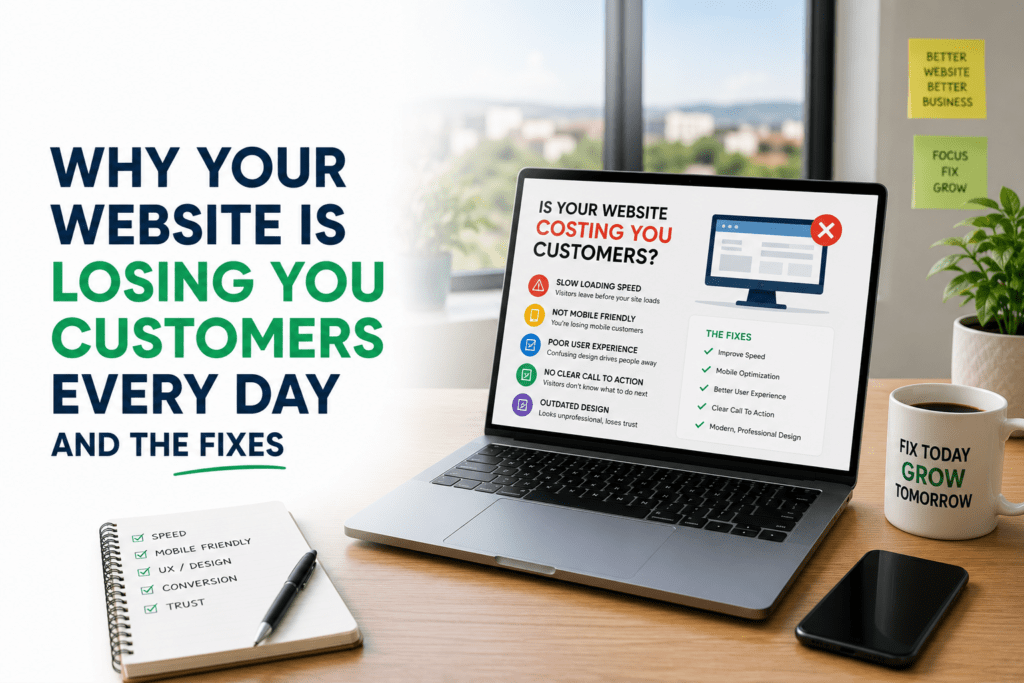
Imagine hiring a salesperson who shows up to every meeting late, dresses unprofessionally, cannot clearly explain what your business does, and loses their notes before the client can ask any questions. You would not keep that salesperson for long. Yet thousands of Nigerian businesses are doing exactly this with their website. Your website is your most important salesperson. It works around the clock, represents your brand to every potential customer who searches for you online, and is often the single deciding factor in whether someone contacts you or closes the tab and calls your competitor instead. The brutal truth is that most Nigerian business websites are not just failing to impress — they are actively driving customers away. And because the damage happens silently, most business owners have no idea it is happening. This article explains why your website is losing you customers every day and the fixes. BEFORE YOU READ ON — QUICK SELF-AUDIT Open your business website on your mobile phone right now. Ask yourself:   ✓  Did it load in under 3 seconds?   ✓  Is everything readable without zooming in?   ✓  Can you immediately tell what your business does and who it is for?   ✓  Is there a clear next step; a button, a call, a form — visible without scrolling?   ✓  Would you trust this website enough to give it your money? If you answered NO to any of these, keep reading. Every issue above is fixable. How Much Is a Bad Website Actually Costing You? Nigerian internet users have become increasingly sophisticated. Years of exposure to well-designed platforms — from Flutterwave and Paystack to Jumia and international brands — have raised expectations significantly. A website that looked acceptable in 2019 can feel untrustworthy in 2026. Consider these realities: 88% of online users won’t return after a bad website experience 3 sec is the maximum load time before most Nigerian users abandon a page 75% of consumers judge business credibility from website design alone 94% of first impressions are design-related, not content-related These are not abstract statistics. For a Nigerian business receiving 500 website visitors per month, even a modest 5% improvement in conversion rate — turning visitors into enquiries — could mean 25 additional leads every month. At a reasonable close rate, that is a significant revenue difference, month after month, compounding indefinitely. Now let us look at exactly what is standing between your visitors and that conversion. 10 Website Mistakes Nigerian Businesses Make (And How to Fix Each One) Mistake 1 — Your Website Loads Too Slowly Speed is not just a user experience issue in Nigeria, it is a fundamental business problem. The majority of your website visitors are on mobile data connections, often on 3G or 4G networks with variable speeds. If your pages take longer than three seconds to load, you will lose the majority of those visitors before they even see your content. Page speed is also a confirmed Google ranking factor. A slow website ranks lower in search results, meaning fewer people find you in the first place. THE MISTAKE THE FIX Images uploaded at full resolution (3–8MB each), no caching, cheap shared hosting on overseas servers, and bloated page builders creating heavy code. Compress all images to under 200KB before uploading. Enable browser caching. Use a hosting provider with servers closer to Nigeria or on a fast African CDN. Consider a lightweight theme. Test monthly with Google PageSpeed Insights (free). Mistake 2 — It Is Not Built for Mobile Phones Over 85% of Nigerian internet users access the web via mobile phones. Yet a large proportion of Nigerian business websites are still built with desktop as the primary consideration — and on mobile, they are a mess. Tiny text, buttons too small to tap, horizontal scrolling, images that overflow the screen. Google uses mobile-first indexing, meaning it primarily judges your website based on its mobile version. A poor mobile experience hurts both your user conversions and your search rankings simultaneously. THE MISTAKE THE FIX Website designed on a desktop computer, tested only on a desktop, with mobile responsiveness treated as an afterthought. Test your website on at least three different Android phones, because that is what most of your Nigerian visitors are using. Use Google’s Mobile-Friendly Test tool (free). Every element- text, buttons, images, forms- must be optimised for a 360–414px screen width. Mistake 3 — Visitors Cannot Tell What You Do Within 5 Seconds When someone lands on your website for the first time, you have approximately five seconds to answer three questions: What does this business do? Who is it for? Why should I care? If your homepage hero section — the first thing visible before scrolling — does not answer all three clearly and immediately, most visitors will leave. This is one of the most common problems on Nigerian business websites. The homepage shows a beautiful photo, a vague tagline like “Providing excellence in all we do,” and no clear indication of what the business actually offers. THE MISTAKE THE FIX Vague hero section with generic tagline, stock photography, and no clear indication of what the business does or who it serves. Rewrite your hero headline to clearly state what you do and who you do it for. Example: “Professional Website Design for Nigerian Businesses — Built to Convert Visitors into Customers.” Add a specific sub-headline. Include one clear CTA button. Test with someone who has never seen your business before — ask them to tell you what you do within 5 seconds of seeing your homepage. Mistake 4 — There Is No Clear Call to Action A website without a clear call to action is like a shop with no till — people browse but have no clear way to buy. Yet many Nigerian business websites make their visitors work to figure out how to get in touch, get a quote, or take the next step. The call to action (CTA) is the specific action you want visitors to

Scroll to Top